Let's consider two illustrations of different ski racers. Figure 1 depicts a hypothetical World Cup slalom skier, while figure 2 shows a representative top junior racer. We'll look at whether the two key components are present in these pictures and how each racer applies them.
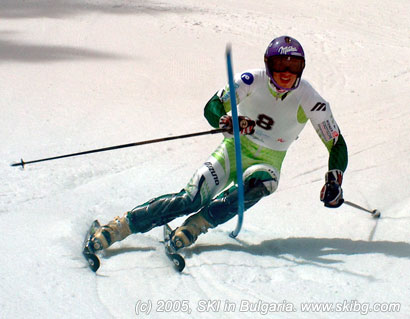 Figure 1 Figure 1
Both illustrations show the same stage of a turn, right before the racer clears the gate with the cross-block technique. The World Cup skier has a very tight line at the gate and applies the most pressure to the edge of his outside ski, which carves fairly cleanly. The ski is bent, and there is a minimal spray of snow. The inside ski is light and isn't bent as much. Virtually no snow sprays from under the ski.
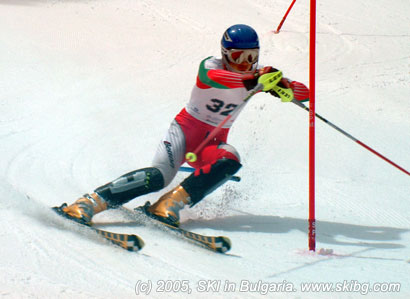 Figure 2 Figure 2
At first glance, the junior racer might seem to be skiing similarly. A closer look at this picture, however, tells a different story. This racer doesn't have as tight a line in approaching the gate as the racer in figure 1. (In itself, this is not a problem. Most juniors are not physically strong enough to ski as tight a line as World Cup skiers.) The junior racer doesn't put enough pressure on the outside ski. In addition, the ski isn't bent very much, and the inside ski is weighted more than it should be. An almost equally big spray of snow comes out from under both skis. The clean carve of the World Cup racer has been replaced by a quick drift, or aggressive slide, through the snow.
The racer who goes too straight and "quick slides" through the gates might be pretty fast for the moment but will suffer from not having developed the basics of a carved turn. Our job as coaches is to correct this kind of skiing before it becomes too ingrained.
Sometimes it's difficult to discern a quick slide from a clean carve. A very fine line distinguishes these two forms of ski behavior. That's why photo and/or video equipment is especially helpful when coaching young athletes.
The ability to carve should be developed by first skiing a line that is more round. Once a racer can successfully carve turns in this line, he or she should gradually work on tightening the line, without sacrificing the carving action of the ski. (Of course, even at the World Cup level, a clean carve does not always happen, but it should be the ultimate goal of any athlete and coach.)
A common mistake made by coaches and racers occurs when a young racer tries to tighten his or her line without correcting the technical errors that prevented him or her from carving turns and skiing fast in the first place. Though these technical errors can vary for every racer, several of the most common are:
- not being balanced over the outside ski
- putting too much weight on the inside ski too early in the turn
- upper-body rotation
- wrong timing of a pole plant
- a lack of forward pressure
- a knocked knee leaning in
Now let's take a more thorough look at the technical elements used by the racers in figure 1 and figure 2. What allows the racer in to make an almost perfect turn? What is the racer in figure 2 missing? The answers to these questions will bring us back to the main topic of this article: effective use of the cross-block technique.
Figure 1
The racer in figure 1 is well balanced over the outside ski. His upper body is stable, and he maintains a countered relationship between his upper and lower body. In addition, his outside leg is well extended, and his outside arm executes the cross-block right in front of the body. All these elements contribute to the proper working of the skis, resulting in a clean carve.
Figure 2
The junior racer in figure 2 also uses the cross-block technique for clearing the gate, but he is missing some of the elements seen in figure 1. For example, since he is not as close to the gate as the racer in figure 1, he has to lean toward that gate in order to clear it with the outside arm. Because he must reach across the body with the outside arm, his upper body is in a rotated position (as opposed to the countered position shown in figure 1). This upper-body rotation causes the racer to lose his balance over the outside ski and therefore apply pressure to the inside ski. As the outside ski loses its grip on the snow, the racer drops his outside knee as he tries to regain the ski's grip. As mentioned earlier, the carved turn in this case ended up as a much slower sliding motion.
The racer in figure 2 would have had a better chance of carving his turns if he had used the inside-arm clearing technique, which would have enabled him to avoid upper-body rotation. As is, the cross-block technique not only did not contribute to the speed of descent, but it in fact reduced speed.
This technical error often carries into GS as well. Up to the World Cup level some racers have had problems with upper-body rotation in GS as a result of having excessively used the cross-block in slalom. For example, according to her coach, Swiss star Vreni Schneider, the most successful female racer of recent years, had a hard time getting rid of the over-rotation in GS turns that carried over from her slalom skiing.
Universal Criteria
The examples of the two racers depicted here allows us to come up with a set of criteria for successfully using the cross-block technique. The following technical elements should be present for a racer to use this technique efficiently:
- a line of descent tight enough to allow the skier to clear the gate with no upper body rotation;
- fore/aft as well as side-to-side balance;
- independent foot work, with a commitment to the outside ski to the point where the ski actually bends;
- consistent timing of pole plants, which provides a higher line of descent.
These basic criteria are universal. They can be applied to any ski racer, from a junior athlete to a college-level competitor to a member of a national development team. Once all the components of the criteria are met, it doesn't take long for a racer to adopt the cross-block technique and start using it efficiently.
The Inside Clear
In addition to the cross-block technique, many World Cup racers also use the inside clear. Raimund Berger, an Austrian ski racing expert, commented on the inside clear in a report for the Austrian Ski Federation: "For those who believe that there is only one technique that will be learned easily by the development skier, the answer is the inside-arm technique. This technique in its most basic form effectively protects the competitor from the poles. Here, it doesn't matter whether the skier is distanced closer or farther away from the gates. A physically weaker skier can easily clear the poles without danger."
Racers like Alberto Tomba and Jure Kosir use the inside clear in most of the combinations in the course. Using the inside clear is recommended for FIS and NORAM racers who end up skiing big ruts in the back of the pack. Based on the above criteria, their line of descent wouldn't be tight enough, and thus the cross-block wouldn't be efficient in such cases. The inside clear can also be used successfully when going through some terrain changes as well as during straight finish sections of a course.
Drills For Gate-Clearing
Any good slalom racer these days should master both the cross-block and inside clear techniques and be absolutely fluent in using them interchangeably. As coaches, of course, we should be able to offer qualified help in this area. Numerous drills exist for developing skill in switching between gate-clearing techniques. I'll share just two of the simplest ones.
The first drill is called "3 x 3 in a corridor." For this drill, about 24 to 30 gates are set in a basic corridor down the fall line. The racer is then given the task of clearing the first three gates with an outside arm, the next three with an inside arm, and so on.
The second drill, the "3 x 3 rhythm change" is a little more complicated. The drill course here consists of a succession of rhythm changes to be made after every three gates. This time the racer is asked to cross-block only the top gate of each three-gate section and inside clear the other two. Once the racer is comfortable doing this, you can change the task. For example, ask the racer to cross-block only the bottom gates of each three-gate section, or to cross-block both the top and bottom ones while inside clearing the middle gate.
These drills should be used with racers who already have strong basic skills and meet every component of the cross-block criteria.
As a working coach, I've seen junior racers from Austria, Slovenia, and Switzerland practice the inside-clear technique over and over during their training camps. In the summer of 1994 I watched Girardelli run bamboo courses, again using only the inside clear. Yet most North American junior racers at the camps at Mount Hood and in Chile concentrate only on the cross-block technique, and some of them haven't yet developed the basics necessary to use it effectively. While timing is very important in skiing, we shouldn't forget that it is equally, if not more, important in coaching.
This article is reprinted from The Professional Skier. All copyrights apply.
Gregory Gurshman is head coach for JI and II racers at Mount Snow Academy in Vermont. He was formerly the downhill coach for the Russian National Ski Team.

| 






























 . ski racing tips





 Categories